
ORINS Membrane–OS
OS Solvent-resistant Nanofiltration Series
OS supports solvent purification, concentration and small-impurity control across common organic solvent systems.
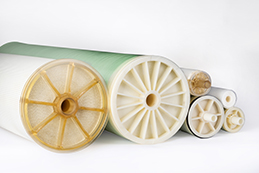
Polymeric membranes portfolio · Category image
PRODUCT OVERVIEW
Characteristics
OS is an ORINS solvent-resistant nanofiltration element for solvent purification, concentration and small-impurity control across common organic solvent systems.
- Reference MWCO 100 Da
- Reference water flux 65 LMH and MgSO4 rejection ≥99.5%
- 1812, 2540, 4040 and 8040 sizes
- Maximum pressure 70 bar and temperature 60°C
TECHNICAL DATA
Specifications and operating conditions
| Element | Material | Active area | Reference flow / flux | MWCO | Feed spacer | Application focus |
|---|---|---|---|---|---|---|
| OS | Solvent-resistant composite membrane | 8040: 28 m² (31 mil)/ 23 m² (46 mil) | 65 LMH | 100 Da | 31 / 46 mil | Solvent purification, concentration and impurity control |
Reference data uses 40 bar, 30°C and 0.2% MgSO4; element flux may vary by approximately ±20% with size and batch.
Published operating limits
- Maximum pressure
- 70 bar
- Maximum pressure drop
- 0.5 bar
- Filtration/cleaning temperature
- ≤ 60°C
- Filtration pH
- 2–12
- Cleaning pH
- 1–13
Reference values and maximum limits do not establish a combined operating condition for every feed. Confirm selection and operating conditions for the actual duty.
APPLICATIONS
Typical applications
- Solvent purification and reuse
- Pharmaceutical concentration
- Catalyst and target retention
- Small-impurity control
SELECTION
Validate with your feed
Compatibility and bench validation are required for the actual solvent, solute, temperature, pressure and concentration.
Testing & scale-upOPERATION
Operating guidance
Confirm solvent compatibility
Validate special solvents, additives and elevated pressure, temperature or concentration before use.
Ramp pressure and temperature smoothly
Avoid sudden pressure or temperature shock during operation and cleaning.
Preserve during shutdown
Keep wet elements immersed in a suitable preservative and sealed during extended shutdown.