
ORINS Membrane–DF
DF Process Separation Nanofiltration Series
DF1–DF6 span approximately 300–3000 Da for high-flux macromolecule concentration, desalination and fractionation.
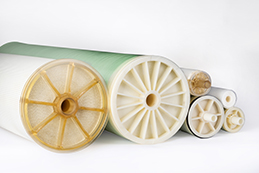
Polymeric membranes portfolio · Category image
PRODUCT OVERVIEW
Characteristics
The DF high-flux process nanofiltration series spans multiple MWCO grades for macromolecule concentration, desalination and fractionation.
- DF1–DF6 cover multiple MWCO grades
- Macromolecule retention with monovalent salt passage
- 34 mil feed spacer for complex feeds
- Consistent screening path from bench to production
TECHNICAL DATA
Specifications and operating conditions
| Element | Material | Active area | Reference flow / flux | MWCO | Feed spacer | Application focus |
|---|---|---|---|---|---|---|
| DF1-8040 | Composite nanofiltration membrane | 365 ft² / 34 m² | 30.7 m³/d | 400–600 Da | 34 mil | Organic concentration and selective desalination |
| DF2-8040 | Composite nanofiltration membrane | 365 ft² / 34 m² | 30.7 m³/d | 300–500 Da | 34 mil | Retention of smaller target molecules |
| DF3-8040 | Composite nanofiltration membrane | 365 ft² / 34 m² | 40.9 m³/d | 800–1000 Da | 34 mil | High-flux macromolecule concentration |
| DF4-8040 | Composite nanofiltration membrane | 365 ft² / 34 m² | 49.2 m³/d | 600–800 Da | 34 mil | High-capacity fractionation |
| DF5-8040 | Composite nanofiltration membrane | 365 ft² / 34 m² | 37.8 m³/d | Approx. 1000 Da | 34 mil | Natural product and peptide concentration |
| DF6-8040 | Composite nanofiltration membrane | 365 ft² / 34 m² | 28.0 m³/d | 2000–3000 Da | 34 mil | Higher-molecular-weight fractionation |
Average permeate flow comes from model-specific test conditions; test pressures differ and values should not be compared without validation.
Reference values and maximum limits do not establish a combined operating condition for every feed. Confirm selection and operating conditions for the actual duty.
APPLICATIONS
Typical applications
- Amino acid and peptide fractionation
- Natural product concentration
- Macromolecule retention
- Scale-up from bench to production
SELECTION
Validate with your feed
DF grades use different reference test conditions and require real-feed comparison of rejection, flux and fouling.
Testing & scale-upOPERATION
Operating guidance
Confirm feed and pretreatment
Check composition, solids, viscosity, temperature, pH and oxidant residue; validate complex feeds at bench or pilot scale.
Fill and vent at low pressure
Fill with a compatible medium and vent air before applying operating pressure.
Ramp to stable operation
Increase pressure and circulation gradually while recording flux, rejection, pressure drop, temperature and recovery.
Monitor fouling and clean
Use a compatible cleaning program when normalized flux declines or pressure drop rises.
Shutdown and preserve
Keep wetted elements wet; for extended shutdown use 1.0% food-grade sodium bisulfite prepared in RO permeate.